

Most Australians spend more time comparing the car than comparing the car loan. And dealerships know it. That is exactly why dealer finance exists at the point of sale, right when your guard is down and your excitement is up.
Dealer-arranged car loans in Australia consistently cost more than loans arranged through an independent broker. Not by a little. By thousands of dollars over a standard five-year term. The dealer adds a margin to the lender’s rate, limits your options to one or two lenders, and bundles the finance into a package that makes it genuinely hard to compare.
With Australia’s used car market softening through 2026, more stock sitting on dealer lots, and average discounts widening, buyers have real negotiating power for the first time in years. But most of that power gets left on the table because the finance decision never gets the same attention as the car decision.
How Dealer Finance Actually Works Behind the Scenes
Most buyers assume the dealership is lending them money. It is not. The dealer acts as a middleman between you and a lender, and earns a margin on the transaction.
Here is how the process works:
- The dealer submits your application to one lender, or a small panel the dealership has an arrangement with.
- The lender provides a “buy rate,” which is the wholesale interest rate for that loan.
- The dealer adds a margin on top. This is called a “dealer reserve” and it is how the dealership earns a commission on your finance.
- You are presented with the marked-up rate as though it is the going rate.
ASIC’s June 2026 Report 832 reviewed over 350,000 car finance loans and found that dealer reserve markups of 1 to 2.5 percentage points were present in 78% of dealer-arranged loans. The same review uncovered establishment fees as high as $9,000 on a single $49,000 loan (Mozo, citing ASIC Report 832, June 2026).
You never see the lender’s base rate. You have no benchmark to compare against. And that is by design.
The Three Ways Dealer Finance Costs You More
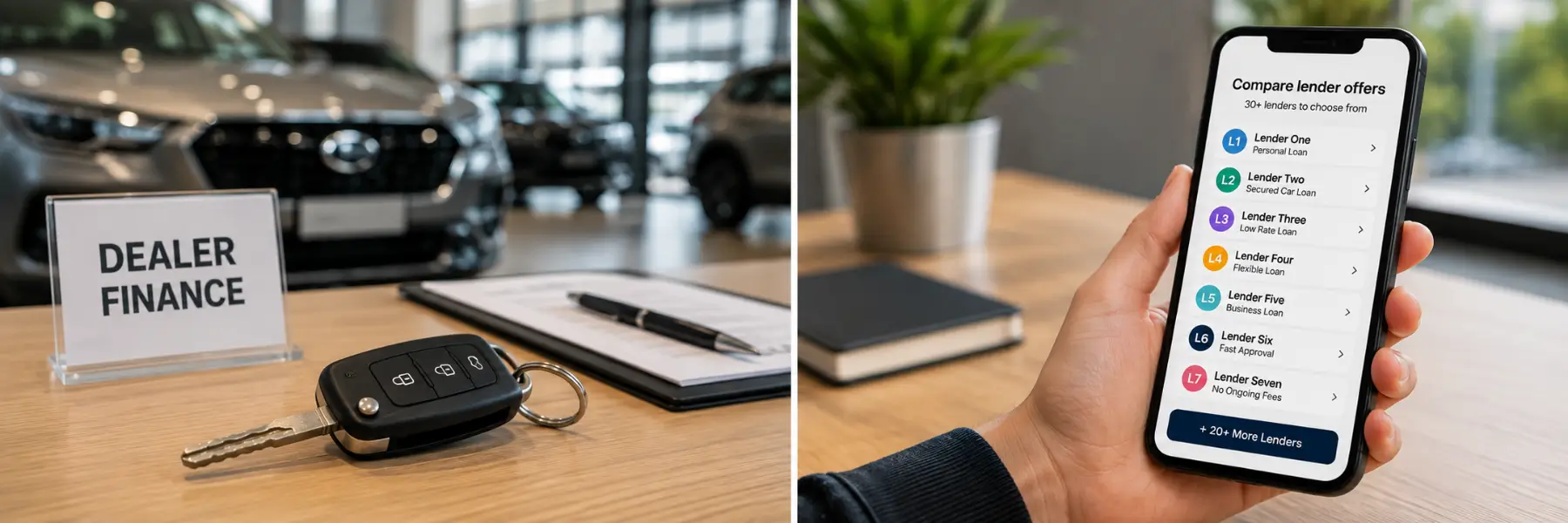
It is not just one added cost. Dealer finance typically hits your wallet in three separate ways.
- Rate margin (dealer reserve)
- The dealer’s cut is baked into the interest rate you are quoted.
- On a $40,000 loan over five years, even a 1.5% rate increase adds roughly $2,000 to $3,000 in extra interest.
- You are never shown the wholesale rate, so you cannot challenge the markup.
- Limited lender choice
- A dealership typically works with one lender, or a handful at most.
- If that lender is not the best fit for your credit profile, you will never know.
- A broker, by contrast, compares your application across 30+ lenders and matches you with the one offering the strongest terms.
- Bundled add-ons you did not ask for
- Extended warranties, gap insurance, paint protection, tyre and rim cover are often packaged into dealer finance.
- These add-ons are frequently rolled into the loan amount, meaning you pay interest on them across the full term.
- Ask for an itemised breakdown before signing. You may be surprised at what has been included.
How a Car Loan Through a Broker Differs
A finance broker takes a fundamentally different approach to arranging your car finance. Here is what you can expect:
- Panel access. Riverwalk Finance compares your application across 30+ specialist lenders, including banks and non-bank providers. You are not limited to one lender’s product.
- Pre-approval before the showroom. You know your budget, your rate, and your repayment before you start shopping for vehicles. This is a significant advantage.
- No margin added. The rate you receive is the lender’s rate. There is no dealer reserve stacked on top.
- Independent advice. Under the National Consumer Credit Protection Act, licensed brokers in Australia are legally required to act in your best interests, not the lender’s and not the dealer’s.
- One credit enquiry. A broker submits one application to the lender best suited to your profile, rather than shotgunning your details across multiple providers.
Want to see how the process works from start to finish? Visit our how it works page.
What Pre-Approved Finance Does to Your Negotiating Position
Walking into a dealership with pre-approved car finance changes the dynamic entirely.
- You negotiate the car price on its own. When the dealer handles both the sale and the finance, the two conversations get blended. A lower car price might come packaged with a higher finance rate, and the saving evaporates.
- You become a cash buyer. From the dealer’s perspective, pre-approved finance is the same as cash. The focus shifts entirely to the vehicle price.
- You hold a real benchmark. If the dealer offers to beat your rate, that is a genuine win. If they cannot, you already have the better deal locked in.
- You avoid pressure. Showroom finance conversations are time-pressured by design. Pre-approval removes the urgency because the finance is already sorted.
The Used Car Market in 2026: Why Getting Finance Right Matters More Now
Australia’s used car market has shifted firmly in the buyer’s favour. According to the Australian Automotive Dealer Association (AADA) and AutoGrab, 1.3 million used vehicles were sold nationally in the first half of 2026, down 6.6% compared to the same period in 2025. By June, more than half of all one-to-five-year-old vehicles were selling below their asking price, with the average discount widening to 3.7% (AADA, July 2026).
What this means for buyers:
- Growing vehicle supply gives you more options and more room to negotiate on price.
- Dealers are competing harder for every sale, which means better deals on the vehicle itself.
- But here is the part most people miss: saving $1,500 on the purchase price is a one-off saving. Saving 1.5% on your interest rate compounds across every repayment over the full loan term.
In a buyer’s market, the real savings sit in the finance, not just the sticker price. Whether you are buying a ute for work, a family car, or a van for the business, getting the loan right is where the numbers shift most.
5 Questions to Ask Before Signing Dealer Finance Paperwork

If you are considering dealer finance, ask these five questions before you sign anything:
- What is the comparison rate, not just the advertised rate? Under Australian law, lenders must display a comparison rate that includes most mandatory fees. This is your true cost indicator.
- What is the total amount I will repay over the full loan term? A monthly figure that sounds reasonable can add up to significantly more than expected across five years.
- Are there any add-on products bundled into this loan? Request an itemised breakdown. Remove anything you did not specifically ask for.
- Can I see the lender’s base rate before the dealer margin is applied? Most dealers will not volunteer this, but it is worth asking.
- Is there an early repayment penalty? Some dealer-arranged products carry exit fees that make it costly to refinance or pay out the loan ahead of schedule.
Not Sure What Rate You Could Get? Let Us Check for You
At Riverwalk Finance, we compare car loan options across 30+ banks and non-bank lenders to find the rate and structure that genuinely fits your situation. There is no cost to enquire, no obligation to proceed, and no dealer margin added to your rate.
If you are thinking about buying a car in the coming weeks or months, a quick conversation with our team can show you what is available before you set foot in a showroom. That way, you walk in with a number, not a question mark.
Get in touch with us today or call us on 0414 917 483. We are based in Truganina, Victoria, and help buyers right across Australia.
Frequently Asked Questions
Can the dealer match my broker’s rate?
Sometimes. It depends on the dealer’s lender panel and the margin they are willing to reduce. Even when a dealer matches the headline rate, check the comparison rate and total fees. A broker-arranged car loan gives you a genuine benchmark to test the dealer’s offer against.
Is dealer finance ever the better option?
Occasionally. Some manufacturers run promotional 0% or ultra-low-rate finance campaigns on specific new models. These are subsidised by the manufacturer and can be genuinely competitive. But read the fine print. They often require a large deposit, short loan terms, or limit you to specific variants. For used cars and standard new car purchases, a broker will almost always find a more competitive deal.
Does applying for car finance through a broker affect my credit score?
A broker typically submits one application to the lender best suited to your profile. This results in a single credit enquiry. By contrast, shopping your own application across multiple banks can generate several enquiries, which may have a cumulative effect on your score. Working with a broker is generally the more credit-friendly approach.
Is dealer finance more expensive than a car loan from a broker in Australia?
Yes. Dealer finance typically includes a dealer reserve markup of 1 to 2.5 percentage points above the lender’s base rate. A broker accesses the base rate directly, with no added margin.
Should I get pre-approved for a car loan before visiting a dealership?
Yes. Pre-approval sets your budget, locks in a competitive rate, and separates the car price negotiation from the finance discussion. It puts you in a stronger position at the showroom.
What is dealer reserve in Australian car finance?
Dealer reserve is a margin the dealership adds to the lender’s wholesale interest rate. The dealer earns commission from this markup, which increases the total cost of your car loan over its term.